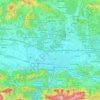
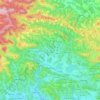
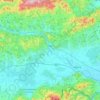
Idrijski Log topographic map
Click on the map to display elevation.
Idrijski Log
Idrijski Log lies on the north end of the Črni Vrh Plateau, which then drops sharply to the Idrijca Valley. It is connected to the hamlet of Podroteja in Idrija by a gravel road with a series of switchbacks and to Godovič by a route known as the French Road (Slovene: francoska cesta), which also leads to Črni Vrh and connects to Zadlog. The settlement lies on heavily karstified wooded land with many karst shafts and losing streams. The main elevations are Krog Hill (794 m), The Hill (Na Griču, 760 m) Grapar Peak (Graparjev vrh, 739 m), Pevc Hill (728 m), Big Peak (Veliki vrh, 721 m), Juniper Hill (Brinov grič, 738 m), Klobučar Hill (694 m), Skalovnik Hill (604 m). Karst caves include the Andrejček Shaft (Andrejčkov brezen) in the hamlet of Koševnik, and the Habeček Shaft (Habečkov brezen) south of this. The water in the shafts drains into Wild Lake and nearby karst springs in Podroteja. Intermittent springs include Pevc Spring (Pevški studenec) and Cold Spring (Mrzli studenec). The most significant watercourse is Mlaka Creek, which disappears into the ground near the Habe farm and formerly powered mills.
About this map

Name: Idrijski Log topographic map, elevation, terrain.
Location: Idrijski Log, Idrija, 5274, Slovenia (45.94135 14.01638 45.98135 14.05638)
Average elevation: 642 m
Minimum elevation: 349 m
Maximum elevation: 802 m
Other topographic maps
Click on a map to view its topography, its elevation and its terrain.


Triglav National Park
Systematic surveys of plants, especially of ethnobotanically useful species, in Triglav National Park have been carried out by Chandra Prakash Kala and Petra Ratajc covering various microhabitats, elevations, aspects, and terrain types. The park has over fifty-nine species of ethnobotanical values, of these 37…
Average elevation: 1,063 m



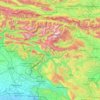

Triglav National Park
Systematic surveys of plants, especially of ethnobotanically useful species, in Triglav National Park have been carried out by Chandra Prakash Kala and Petra Ratajc covering various microhabitats, elevations, aspects, and terrain types. The park has over fifty-nine species of ethnobotanical values, of these 37…
Average elevation: 1,063 m



Soča
An Alpine river in character, its source lies in the Trenta Valley in the Julian Alps in northwestern Slovenia, at an elevation of 876 metres (2,874 ft). The river runs past the towns of Bovec, Kobarid, Tolmin, Kanal ob Soči, Nova Gorica (where it is crossed by the Solkan Bridge), and Gorizia, entering the…
Average elevation: 562 m


Karst Plateau
It lies between the Vipava Valley, the low hills surrounding the valley, the westernmost part of the Brkini Hills, northern Istria, and the Gulf of Trieste. The western edge of the plateau also marks the traditional ethnic border between Italians and Slovenes. The region gave its name to karst topography. For…
Average elevation: 285 m




Piran / Pirano
The Municipality of Piran borders Croatia to the south and the municipalities of Izola and Koper to the east, and it faces Italy across the Gulf of Trieste and the Adriatic Sea. The highest point, Baretovec pri Padni, has an elevation of 289 meters (948 ft).
Average elevation: 33 m




Piran / Pirano
The Municipality of Piran borders Croatia to the south and the municipalities of Izola and Koper to the east, and it faces Italy across the Gulf of Trieste and the Adriatic Sea. The highest point, Baretovec pri Padni, has an elevation of 289 meters (948 ft).
Average elevation: 34 m